The Software Data Goldmine: Why AI Labs Pay $300K–$450K+ for Past ServiceTitan & Procore History
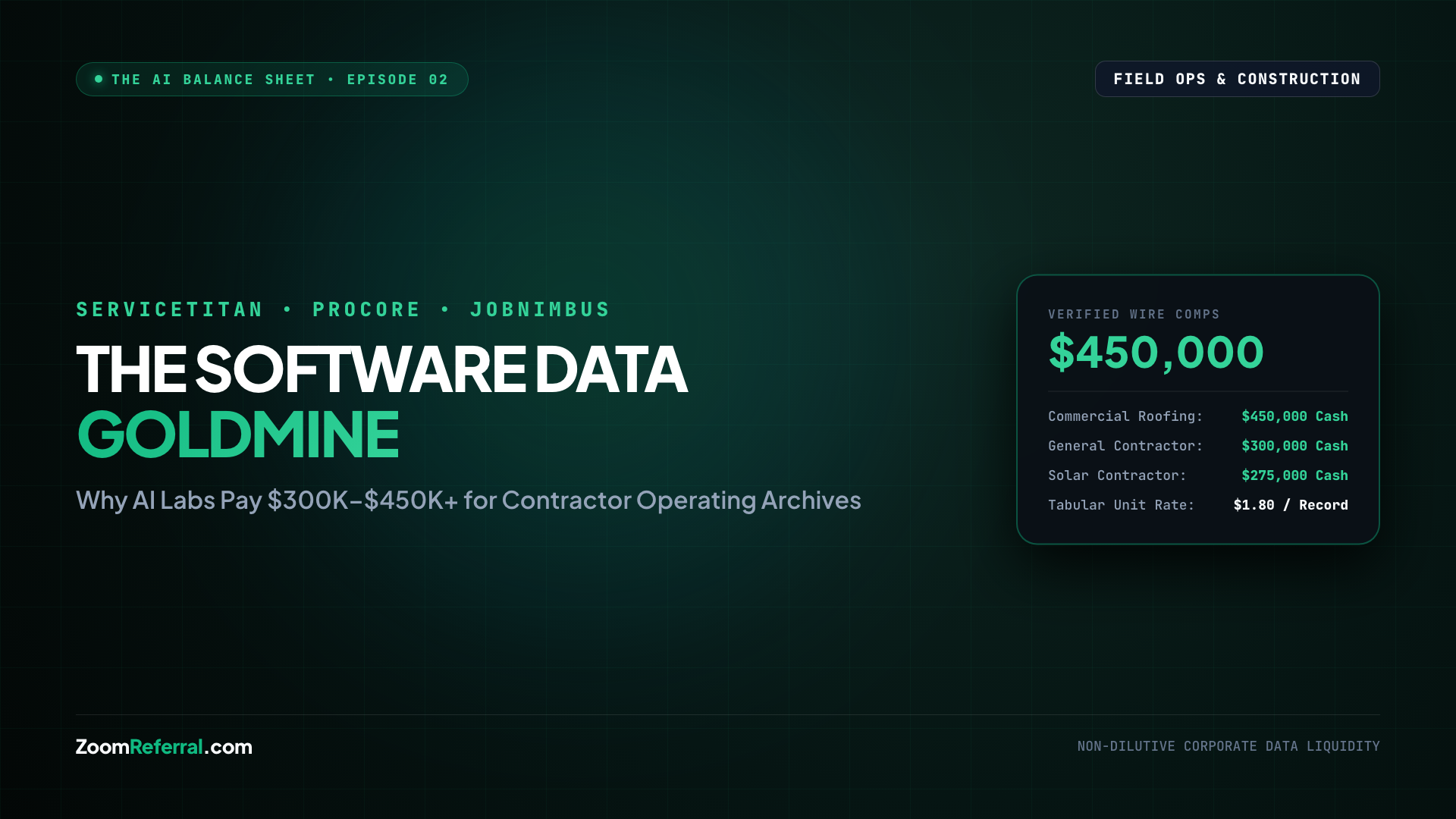
Monetizing Contractor Software History
Commercial contractors running ServiceTitan, Procore, or JobNimbus for 5+ years carry latent non-dilutive balance sheet assets ($300K–$450K+). No equity sold, no debt, and 100% blind PII redaction.
Inside the Contractor Data Goldmine
Commercial trade operators—roofing companies, commercial general contractors, HVAC mechanical firms, and civil infrastructure builders—are sitting on what has quietly become the most fiercely contested training asset in artificial intelligence.
Frontier foundation models like GPT-4o, Claude 3.5 Sonnet, and Gemini 2.0 were trained on public web scrapings. But they hit an immediate failure mode when applied to physical construction and trade mechanics: the real world does not run on Wikipedia articles.
Applied vertical AI startups backed by billions in venture capital cannot scrape the truth about how a 12,000-square-foot commercial roof tear-off is estimated after hail damage, or how a general contractor negotiates 22 change orders on a multi-million-dollar hospital renovation. That operational ground truth is locked inside enterprise software instances of Procore, ServiceTitan, and JobNimbus.
2026 Contractor Software Valuation Index
* Offer floor begins at $100,000 for qualifying enterprise datasets. Standard deal cycle: 14-day close.
Verified Transaction Case Comps
Perpetual exclusive license to historical operational record and job logs. 100% blind anonymization before delivery.
Exclusive operational build history license to applied construction AI laboratory for workflow automation models.
Non-dilutive licensing capital used for fleet expansion with zero equity dilution and zero debt.
The 4-Layer Security & Trade Privacy Shield
- Zero Data Ingestion During Valuation: No API access, credentials, or file uploads required to receive preliminary appraisal.
- Mutual Non-Disclosure Agreement: Legally binding confidentiality executed before technical review.
- Two-Person Identity Firewall: Downstream AI buyers never learn your corporate identity, location, or customer names.
- Certified Cryptographic Sanitization: Job site addresses, customer names, telephone numbers, emails, tax IDs, and confidential subcontractor rate sheets are permanently redacted before model ingestion.
How Much Is Your Software Stack Worth?
Discover what AI buyers are willing to pay for your historical operating records. Get an institutional valuation estimate in under 2 minutes based on real closed deal comps.
Episode 02 Full Transcript
Host: Welcome back to The AI Balance Sheet, the executive briefing on how established commercial enterprises turn years of operational history into seven-figure, non-dilutive balance sheet capital. I am your host, and today we are diving into the single most sought-after asset class in artificial intelligence right now: specialized field operations and construction software data.
Host: If you own or operate a commercial contracting firm, a multi-crew roofing company, an HVAC mechanical contractor, or a civil infrastructure business with thirty or more employees and five or more years on platforms like ServiceTitan, Procore, JobNimbus, or Buildertrend, you are sitting on an unencumbered corporate asset that did not exist two years ago.
Host: In our published track record, an established commercial roofing contractor received a written four hundred and fifty thousand dollar wire payout for a perpetual exclusive license to their historical operational record, completely anonymized before delivery. A commercial general contractor secured three hundred thousand dollars. An established solar company secured two hundred and seventy-five thousand dollars. Zero equity surrendered. Zero debt taken on. Zero changes to their daily operations or software systems.
Host: In this briefing, we are going to break down why vertical AI labs are hunting for your past dispatch logs, change orders, and submittals, the exact unit valuation formulas they use to price your database, and how to safely monetize that software archive with zero risk to client privacy or your competitive advantage.
Host: To understand why a software database from a five-crew roofing company or a fifty-technician mechanical contractor is worth hundreds of thousands of dollars, you have to understand the fundamental limitation of general-purpose artificial intelligence. Frontier models like GPT-4o, Claude 3.5 Sonnet, and Gemini 2.0 were trained on the public web. They have digested billions of lines of Wikipedia articles, social media discussions, code repositories, and online textbooks. They can write poetry, summarize legal briefs, and generate basic software code. But they have no idea how a commercial building actually gets built, repaired, or maintained in the real world.
Host: When a multi-billion dollar venture capital fund backs an applied vertical AI startup to automate construction estimating, project management, or HVAC dispatch scheduling, that AI company hits a wall on day one. The training data simply does not exist on the public internet. You cannot scrape the truth about how a real-world roof replacement is priced after hail damage. You cannot scrape the real-world delta between an initial electrical bid and the final twenty-two change orders executed on a six-story hospital project. You cannot scrape the customer objection recordings when an industrial compressor fails in the middle of an August heatwave. That operational ground truth is locked inside private enterprise instances of Procore, ServiceTitan, JobNimbus, and Jobber.
Host: And because synthetic data, where AI models generate artificial training scenarios, creates compounding hallucinations when applied to complex physical trades, these vertical AI labs have only one viable path to market: they must purchase historical software training licenses from real, established American operators.
Host: So what specific records inside your software stack are AI labs buying? It is not generic customer lists or contact phone numbers. Buyer models do not care about who your customers are. They care about the mathematical syntax of how your business solves operational problems.
Host: Let us look at the core software ecosystems. First, Procore and commercial construction platforms. Vertical construction AI companies are training models to automate estimating, safety compliance, and schedule slippage. The highest-value data records inside Procore include completed submittals and requests for information, showing how engineering discrepancies were resolved in the field. They look for material change orders showing initial estimates versus finalized costs across five to ten years of commercial projects. They buy daily construction logs tracking weather conditions, crew sizes, subcontractor delays, and inspector sign-offs. And they analyze closeout documentation showing historical variance between bid schedules and actual completion dates.
Host: Second, ServiceTitan and field service platforms. In mechanical, electrical, plumbing, and roofing services, applied AI labs are training autonomous dispatch and pricing algorithms. Inside ServiceTitan, they look for five to ten years of completed work orders detailing technician diagnosis notes, parts replaced, and hours on site. They look for dispatch routing telemetry showing response times, drive times, and schedule reallocations during peak seasonal demand. They buy pricebook configurations and historical margin structures across tens of thousands of past residential and commercial service calls. And they value customer communication logs showing how pricing objections were negotiated and resolved.
Host: Third, specialty platforms like JobNimbus, Buildertrend, and Housecall Pro. Here, buyers focus on material procurement timelines, insurance claim dispute documentation, and job-site inspection photo histories. Each of these data streams represents ground-truth human decision-making that cannot be simulated.
Host: How does this translate into balance sheet value? At ZoomReferral.com and our principal buyer network, valuations are determined using an empirical token-density framework benchmarked against historical transactions.
Host: Here is the exact unit breakdown. Number one: structured operational and job records. In platforms like ServiceTitan, Procore, or custom relational databases, structured tabular records, including completed work orders, change orders, dispatch tickets, and billing histories, benchmark at approximately one dollar and eighty cents per verified record. If your business has completed seventy-five thousand service tickets, maintenance logs, and supply records across seven years, that tabular layer alone carries an estimated gross baseline of one hundred and thirty-five thousand dollars.
Host: Number two: field notes and unstructured text archives. Technician diagnostic notes, estimator commentary, scope-of-work narratives, and multi-year project management emails benchmark at up to one hundred and eighty dollars per uncompressed gigabyte, which scales to one hundred and eighty thousand dollars per terabyte.
Host: Number three: spoken audio and dispatch telephony. If your firm records customer inbound calls, emergency dispatch communications, or technician debriefs on platforms like RingCentral, CallRail, or Gong, clean two-party telephony audio benchmarks at eleven dollars per recorded hour. A twenty-line operation logging five thousand hours per year builds fifty-five thousand dollars in latent asset value annually.
Host: Transactions start at our standard offer floor of one hundred thousand dollars, with multi-system field-ops archives commonly securing wires between three hundred thousand and eight hundred thousand dollars. And remember: this is a non-dilutive asset sale. You do not issue equity. You take on no debt. You do not give up your software licenses or surrender access to your past records. You simply license an anonymized mathematical copy of your past operating history.
Host: Now, every business owner’s immediate reaction is sensible: I cannot give an AI company access to my clients' home addresses, my subcontractor rates, or my private blueprints. And you are entirely correct. You should never upload raw files or hand over software credentials to an unvetted buyer.
Host: At Zoom Referral, our origination process is engineered around a four-layer institutional compliance shield designed specifically for commercial contractors and business owners. First: zero data leaves your system during valuation. To receive an institutional valuation, you do not connect your API, export databases, or upload files. The initial qualification takes two minutes. You simply specify which software platforms you run, such as Procore or ServiceTitan, your approximate employee count, and the number of years the platform has been in continuous operation.
Host: Second: a mutual non-disclosure agreement. Before any sample review or diligence occurs, a legally binding mutual non-disclosure agreement is executed, protecting your company identity and proprietary methods.
Host: Third: the two-person identity firewall. Your corporate identity is permanently firewalled. Only executive principals ever see your corporate name alongside data summaries. Downstream AI labs never know the name of your contracting firm or the city where your projects were built.
Host: And fourth: certified cryptographic data scrubbing. Before a single byte of historical data is delivered to a buyer, the entire archive undergoes rigorous third-party de-identification. Every customer name, physical job site address, phone number, personal email, tax identification number, and proprietary subcontractor pricing formula is stripped and permanently masked. The buyer receives only the abstract mathematical relationships, such as how a twelve-hundred-foot commercial roof tear-off behaves under specific labor and material parameters, never who the client was or where the building stands.
Host: You retain full legal ownership of your data, you continue operating on your software systems without interruption, and your clients’ privacy remains one hundred percent uncompromised.
Host: If your company runs ServiceTitan, Procore, JobNimbus, or any commercial field-operations platform with five or more years of history, you are sitting on working capital that could fund new equipment, weather economic seasonality, or provide liquidity without giving away equity.
Host: To see what your software archive is worth in today’s institutional buyer market, head to ZoomReferral.com/valuation/servicetitan if you run ServiceTitan, or ZoomReferral.com/valuation/procore if you operate on Procore. You can also visit our main valuation hub at ZoomReferral.com/valuation. Enter your software tools, your approximate team size, and your operating history. In under two minutes, you will receive an anonymous preliminary valuation estimate based on real closed transaction comps.
Host: Thank you for listening to The AI Balance Sheet. Subscribe wherever you get your podcasts, and we will see you in the next briefing.